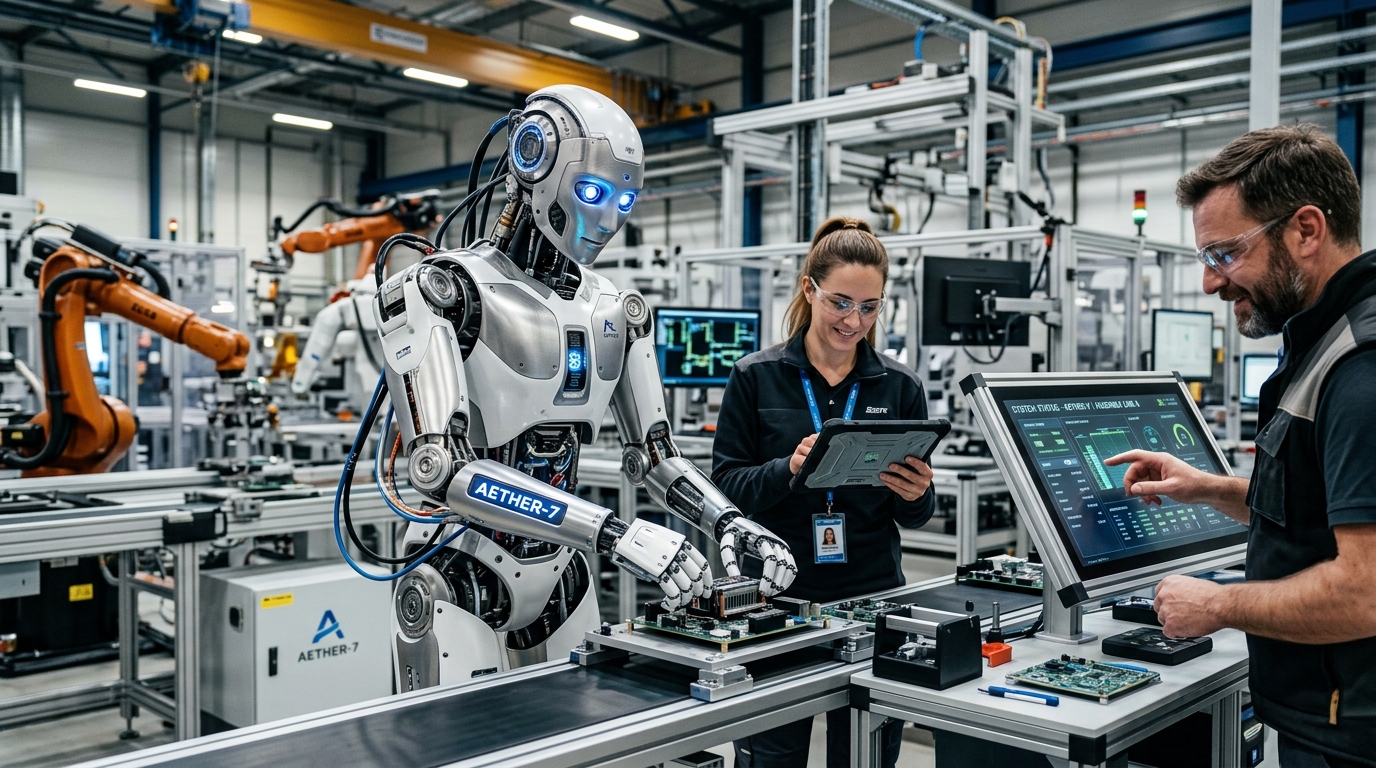
Earlier robotics required rigid programming for every millimeter of arm movement. The breakthrough behind the latest generation of humanoid robots lies in Vision-Language-Action (VLA) foundation models. By marrying visual transformer encoders with continuous robotic motor controllers, humanoids can now:
Earlier robotics required rigid programming for every millimeter of arm movement. The breakthrough behind the latest generation of humanoid robots lies in Vision-Language-Action (VLA) foundation models. By marrying visual transformer encoders with continuous robotic motor controllers, humanoids can now:
- Understand natural voice and visual commands from factory supervisors.
- Adapt dynamically to shifted components, fallen obstacles, and changing lighting conditions.
- Learn complex manipulation workflows through short video demonstration and synthetic reinforcement learning.
Collaborative Safety & Human-Centric Environments
Modern automotive factories and electronics assembly hubs are designed around human proportions — standard doorways, stairwells, and tool racks. Bipedal humanoid robots integrate directly into these existing human workspaces without requiring multi-million-dollar plant re-engineering.